
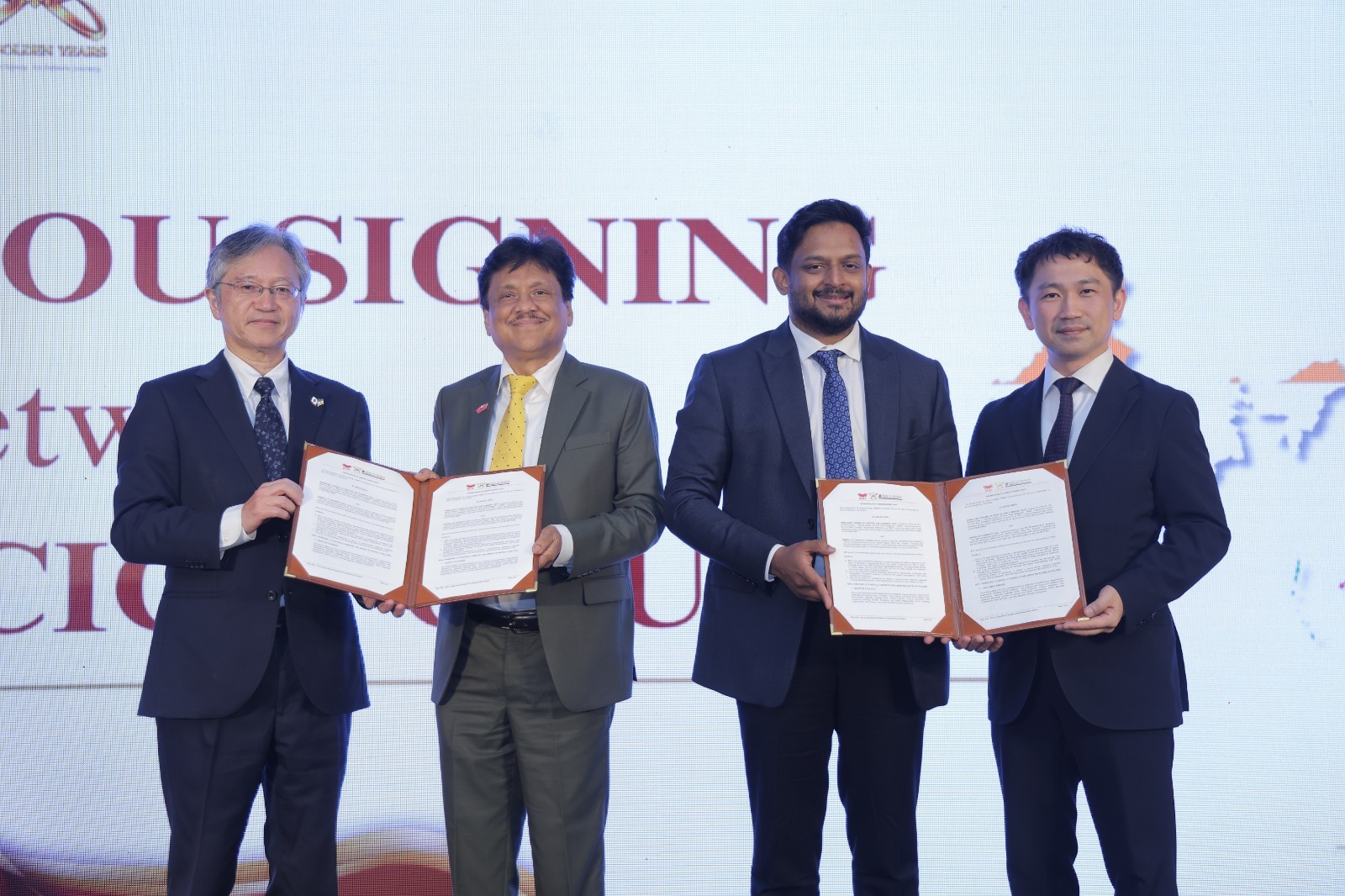
From left to right: Mr. Hiroshi Nawata, Consul General of Japan in Bengaluru; CA K. Ravi, President, Bangalore Chamber of Industry and Commerce; Dr. Christo Joseph, FRSA, Director – Strategy & Planning, Garden City University; and Mr. Hirotsugu Ueda, Vice Governor of Tokushima Prefecture, Japan, during the MoU exchange at the 4th India–Japan Business Summit 2026 in Bengaluru.
Partnership to introduce Japanese language training, professional skill development and international career readiness programmes for students
Bengaluru, 4 November 2026: Garden City University (GCU) has signed a Memorandum of Understanding (MoU) with the Bangalore Chamber of Industry and Commerce (BCIC) to strengthen industry-academia collaboration and prepare students for emerging career opportunities within Japanese companies and the broader India–Japan business ecosystem.
The MoU was formally exchanged during the 4th India–Japan Business Summit 2026, held in Bengaluru on 2 November 2026, in the presence of Mr. Hiroshi Nawata, Consul General of Japan in Bengaluru, and Mr. Hirotsugu Ueda, Vice Governor of Tokushima Prefecture, Japan.
The exchange took place alongside CA K. Ravi, President of BCIC, and Dr. Christo Joseph, FRSA, Director – Strategy & Planning, Garden City University.

Organised by BCIC in association with Tokushima Prefecture, Japan, under the theme “Make in India with Japan, for the Globe”, the summit brought together senior government representatives, Japanese diplomatic officials, industry leaders and academic institutions to strengthen economic, technological and educational cooperation between India and Japan.
The agreement establishes a framework for the Japan Market Readiness & Finishing School Initiative, aimed at equipping students with the language skills, cultural understanding and professional competencies required to engage effectively with Japanese industries.
A key component of the initiative is a structured 40-hour Japanese language training programme, complemented by cross-cultural communication, corporate etiquette, professional grooming, interview preparation and industry-focused skill development. The programme will introduce students to Japanese workplace practices and foundational language proficiency aligned with Japanese Language Proficiency Test (JLPT) N5/N4 benchmarks.
The collaboration will also facilitate industry-academia masterclasses, guest lectures, cultural immersion activities and exposure to Japanese recruitment practices. Students from engineering, information technology, management and life sciences are expected to benefit from the initiative.
Through its extensive industry network and international connections, including established links with Tokyo and Osaka, BCIC will support industry engagement, professional exposure and the development of potential internship and placement pathways.
Speaking on the collaboration, Dr. Christo Joseph, FRSA, Director – Strategy & Planning, Garden City University, said:
“International collaboration in higher education must go beyond signing agreements. It must create meaningful opportunities for our students.
Japan offers tremendous possibilities in technology, manufacturing, innovation and several other sectors. However, accessing these opportunities requires more than academic qualifications alone. We must prepare our students with the language skills, cultural understanding, professional competence and adaptability required to succeed in a global environment.
Our partnership with BCIC is an important step in connecting education with industry. I believe universities have a responsibility not only to educate students but also to equip them with the confidence and capabilities to explore opportunities beyond geographical boundaries.”
The initiative comes at a time when Karnataka and Japan are strengthening their economic and industrial engagement, particularly in manufacturing, technology, innovation and talent development.
As international business relationships expand, the demand for graduates who possess both technical expertise and cross-cultural competencies is becoming increasingly important.
The programme will include continuous assessments, with successful participants receiving jointly branded certificates. High-performing students may also be recommended for advanced language immersion, corporate internships and potential placement pathways with participating Japanese enterprises.
For Garden City University, the agreement reflects its broader commitment to internationalisation, industry engagement and creating educational experiences that extend beyond the classroom.
The partnership seeks to translate growing India–Japan cooperation into meaningful educational and professional opportunities for the next generation.