
Last date for PG admissions is 10th Oct 2025

MBA vs Working Straight Out of College: What the Salary Data Actually Says

An MBA is a two-year postgraduate degree built around business strategy, finance, marketing, and leadership. It’s usually the first big career fork graduates hit after finishing their undergrad, and the decision tends to arrive faster than expected. Some jump straight into a job, take the first solid offer, and start building experience right away. Others pause, take the degree, and come back to the job market a couple of years later with a different title and a different salary expectation. Both routes carry real trade-offs, in time, in money, and in how quickly a career gains momentum. Neither path is automatically the smarter one, no matter how confidently either side gets pitched online. It depends on the salary data, the timing, and the actual career goal, once you set emotion and pressure aside and look at the numbers directly.

What an MBA Actually Changes About Your Career

An MBA doesn’t just add two letters after your name. It changes the kind of roles you’re eligible for on day one of your next job search. Fresh graduates without it usually start in execution-heavy roles: analyst, associate, junior specialist. This programme is built around case studies, strategy projects, and leadership training. Because of that, graduates often step into roles one or two levels higher than they’d have qualified for otherwise.

That said, this jump isn’t automatic. A student who does the degree straight after a bachelor’s, with no real work experience in between, tends to see a smaller salary bump. Someone who worked for two or three years first usually does better. Recruiters value the credential more when it’s paired with prior context, not used as a substitute for experience.

The Salary Data: MBA vs. Working Straight Out of College

Here’s where the numbers actually matter. Someone who starts working right after their undergraduate degree typically earns an entry-level salary from year one. Raises are tied to performance and tenure from the start. Someone doing an MBA instead spends two years paying tuition. In many cases, they give up that entry-level income entirely.

The break-even point usually shows up around year four or five after graduation. By that stage, graduates in management, consulting, or finance roles tend to out-earn the direct-to-work path, sometimes by a wide margin. But someone who started working immediately has a two-year head start. That head start covers raises, promotions, and workplace experience that a classroom can’t fully replicate.

So the honest answer is: an MBA usually pays off, but not immediately, and not for every field. Someone heading into a tech-heavy or highly technical career often sees less salary lift from it. Someone aiming for general management, consulting, or a leadership track tends to see more.

When Working Straight Out of College Makes More Sense

Not every career benefits from a pause for postgraduate study. If you already know the exact role and industry you want, working straight out of college can put you ahead faster. That’s especially true in fields that reward hands-on experience over credentials. Software engineering, design, and several creative fields fall into this category. A strong portfolio often outweighs an MBA on a resume in those spaces.

Working first also removes some of the guesswork. Two or three years in a real job clarifies what specialization would actually be useful, whether that’s finance, operations, or marketing. Students who choose an MBA without that clarity sometimes end up with a broad, expensive degree. It doesn’t always map cleanly onto the career they actually want.

When an MBA Is Worth the Investment

An MBA tends to pay off fastest for people aiming at roles where the degree itself is a filter, not just a nice-to-have. Consulting firms, investment banks, and many corporate leadership tracks explicitly prefer or require one. In those fields, skipping it can quietly cap how high you can climb, no matter how good your work is.

It also matters for people looking to pivot industries entirely. Switching from engineering into finance or general management is much easier with this degree on the resume. It signals a formal grounding in business fundamentals that a technical résumé doesn’t show on its own.

Cost is the other half of this decision. A full-time MBA usually means tuition plus two years of lost income. The math only works if the expected salary jump comfortably covers that gap within a reasonable number of years. Part-time and executive programmes exist specifically to soften this trade-off, letting people keep earning while they study.

FAQ

No. It improves the odds and the ceiling, especially in consulting, finance, and general management. The actual lift depends heavily on prior experience, specialization, and the hiring market at the time

For most people, yes. Two to three years of work experience beforehand tends to produce a bigger salary jump than doing the degree immediately after undergrad, since recruiters value the combination of experience and credential.

Most graduates see a break-even point around four to five years after finishing the programme, once tuition and lost income are weighed against the higher starting salary in the new role.

Highly technical, portfolio-driven fields like software engineering and design tend to reward hands-on skill over a business degree. The salary lift is usually smaller there.

Conclusion

There’s no universal right answer between an MBA and working straight out of college. It depends on the industry, the timing, and what the role actually rewards once you’re in it. A consulting career leans hard toward the degree. A design or engineering career often doesn’t need it at all, at least not early on. What matters more than picking the “correct” path is being honest about which trade-off you’re willing to make: two years of lost income now, or a slower climb toward the same seniority later. For students weighing this decision, it helps to talk it through with people who’ve seen both paths play out. Garden City University‘s MBA programme is one option worth exploring once you’ve worked out which side of that trade-off fits your goals.
BSc Forensic Science: What the Job Actually Looks Like (Not What CSI Shows You)

A BSc Forensic Science degree trains students to work with physical evidence, lab analysis, and courtroom procedure. It’s not the dramatic crime-solving montage most people picture. It’s a three-year science degree built on chemistry, biology, and criminology, with a heavy emphasis on lab technique rather than field investigation. Nobody on a real forensic team solves a case in forty minutes, and almost nobody carries a badge or interrogates a suspect. Most of what actually happens takes place under fluorescent lab lighting, not in a dramatic interrogation room. The gap between the TV version and the actual job is bigger than most students expect, and it shapes everything from the coursework to the pace of an actual career. It’s worth understanding before you commit three years to it, especially since the field rewards a very different temperament than the one crime shows tend to glamorise.

What a BSc Forensic Science Degree Actually Covers

The core of a BSc Forensic Science programme is lab science, not detective work. Expect heavy coursework in organic chemistry, toxicology, biology, and pathology. Specialised modules like fingerprint analysis, ballistics, and crime scene photography sit alongside that base. Because of that, most of the first year looks a lot like a regular chemistry or biology degree. The forensic-specific content builds up gradually from the second year onward.

There’s also a strong statistics and data-interpretation component that surprises students who assumed the degree was pure chemistry and biology. Practical lab work is central to how this subject is taught. Students spend real hours running tests and documenting chain of custody. They also learn to write reports that could hold up if challenged in court. That documentation piece surprises a lot of first-years, because procedural writing isn’t something CSI ever shows on screen.

The Reality vs. the TV Version

On television, one person seems to do everything. Collect evidence, run every test, interview suspects, deliver a dramatic reveal, all before the episode ends. In a real lab, roles are split across specialists. For instance, a DNA analyst doesn’t usually process fingerprints. A toxicologist doesn’t typically work ballistics. Each of these is its own career track, built on the same base degree but branching hard after graduation.

Turnaround time, too, is another big myth. DNA results that appear in an hour on screen can take weeks in an actual lab. Backlog is part of the reason. Rigorous testing simply takes time, too. A BSc Forensic Science graduate learns early that patience and precision matter more than speed. Rushing a test to meet a deadline is exactly how evidence gets challenged and thrown out later.

What the Job Actually Looks Like Day to Day

In practice, most graduates don’t end up standing over a body at a crime scene. A large share of forensic science jobs are lab-based. Running samples, calibrating equipment, cross-checking results, and writing up findings in painstaking detail fills most days. Crime scene visits do happen, but they’re a smaller slice of the role than most students assume going in.

However, courtroom testimony is another part of the job that rarely gets mentioned early on. Forensic scientists sometimes have to explain their findings to a judge, a jury, and two opposing lawyers. It has to be in plain language that non-scientists can follow. That skill matters just as much as the science itself once a case goes to trial. Explaining complex lab results simply and confidently isn’t optional.

Salaries also vary a lot depending on which branch a graduate ends up in, with government lab roles often paying less initially than private consulting or pharmaceutical positions. Career paths after a BSc Forensic Science degree branch in a few directions. Some graduates join government forensic labs or police departments directly. Others move into private forensic consulting, pharmaceutical quality control, or even digital forensics. The analytical mindset transfers well beyond crime labs specifically.

Is a BSc Forensic Science Degree Worth Pursuing?

For students genuinely drawn to lab work, chemistry, and methodical problem-solving, this degree makes a lot of sense. It’s a strong fit for anyone who likes structure and doesn’t mind repetitive testing procedures. Handling occasionally disturbing material without losing focus matters too. That last part matters more than people expect walking in.

That said, it’s a weaker fit for students who picked the subject purely because a TV show made it look exciting. The real job rewards patience over drama, and documentation over instinct. Students expecting constant high-stakes investigation work often find the real pace slower than they’d hoped. Lab-based work rewards patience over adrenaline.

FAQ

No, that’s law enforcement, not forensic science. Forensic scientists analyse evidence and report findings; police officers and detectives handle arrests and active investigation.

Most graduates can enter entry-level lab roles right after finishing the degree. Specialised roles like DNA analysis or toxicology sometimes require additional certification or a master’s degree on top of that.

Yes, heavily. Organic chemistry and biology form the backbone of most forensic testing methods. Students who struggle with lab science generally find this degree difficult.

Pharmaceutical quality control, environmental testing, private forensic consulting, and digital forensics all regularly hire graduates from this background. The analytical training transfers well beyond crime labs.

The job is slower, more procedural, and far less dramatic than television makes it look. That’s exactly what makes it dependable work for the right kind of student, since real evidence handling depends on consistency rather than dramatic breakthroughs. A BSc Forensic Science degree rewards patience, precision, and a genuine interest in lab science over crime-drama excitement, and that trade-off tends to become clearer with every semester of actual coursework. For students who find that trade-off appealing rather than disappointing, that’s usually a good sign about how well the career will actually suit them. Garden City University‘s forensic science programme is worth a closer look from there, particularly for students who want to see how the lab-based reality compares to the version they walked in expecting.

MCA

MCA Explained: Who It’s Actually For, and Who Should Skip It

MCA, or Master of Computer Applications, is a postgraduate degree focused on software development, programming, and computer systems. It’s typically pursued after a bachelor’s degree in any stream. It sits in an odd spot in most people’s minds. Some think of it as “engineering for people who didn’t do engineering.” Others assume it is only for hardcore coders who eat, sleep, and breathe C++. Neither picture is entirely accurate. That confusion is exactly why so many students pick this course for the wrong reasons, or skip it for equally wrong ones.

This piece is an attempt to cut through that noise. Instead of listing generic pros and cons, it looks at who genuinely benefits from an MCA and who tends to struggle. It also covers what the actual day-to-day experience involves once the excitement of enrolment wears off.

Who an MCA Is Actually Built For

The clearest fit is a student who studied something other than computer science at the undergraduate level, such as B.Sc Mathematics, B.Com, or even BA Economics, but wants to pivot into software or IT roles. An MCA assumes no prior coding background. It usually starts with the fundamentals of programming, often in Python or Java, before moving into data structures, database management, and web technologies.

That said, career-switchers are not the only ones who benefit. Students who did complete a computer science-adjacent degree, like BCA, also join in large numbers. Mainly, they want deeper specialisation in areas like cloud computing, cybersecurity, or data analytics through an MCA. For this group, the first few months can feel repetitive, since core programming concepts overlap with what they already studied. However, the pace usually picks up by the second semester, once subjects turn toward advanced topics like machine learning or software engineering practices.

There is also a smaller but steady group of working professionals who enrol to formalise skills they picked up on the job. Someone who has been doing basic scripting or database work for two or three years often finds that an MCA gives their resume the credibility it was missing. That holds even if the coursework itself feels familiar in places.

Who Should Think Twice About an MCA

Not everyone thrives in this kind of programme, and that is worth saying plainly. Students who genuinely dislike logical problem-solving often find the transition harder than expected. The same goes for those who found even basic mathematics stressful in school. Subjects like data structures and algorithms are not optional electives here. They form the backbone of the entire degree, and struggling with them early tends to create a snowball effect by the third semester.

An MCA leans heavily on lab work, coding assignments, and mini-projects. Students who prefer memorising notes over building things from scratch usually find the format frustrating rather than rewarding. A typical semester might include building a small web application, writing SQL queries for a mock database, or debugging code for hours during a lab session. That hands-on pressure does not suit every learning style.

Finally, students hoping for a quick, low-effort path to a “tech degree” tend to fall behind quickly if they skip consistent practice. An MCA is not a course where cramming the week before exams gets you far. Practical skills accumulate over time rather than appearing overnight.

What MCA Coursework Actually Looks Like

A typical MCA first year usually includes Programming Fundamentals, Data Structures, Database Management Systems, and Computer Networks. A mathematics-heavy subject like Discrete Structures is usually part of the mix too. By the second year, students usually branch into electives such as Machine Learning, Cloud Computing, or Mobile Application Development, depending on the university’s offerings.

Assessment methods also differ from a typical arts or commerce degree. Instead of long descriptive answers, students submit working code, presentations of mini-projects, and lab records. These get evaluated continuously through the semester. Because of this, attendance in lab sessions often matters just as much as attendance in lectures. Missing even two or three sessions can leave real gaps in practical understanding.

Group projects are common too, particularly in the final year. Students often build a complete application as part of their capstone requirement, ranging from an inventory management system to a basic e-commerce platform.

MCA Career Outcomes Worth Knowing About

Placement outcomes for this degree tend to vary based on specialisation and internship experience rather than the degree title alone. Students who pick up internships in software development or data analytics during their second year generally see stronger placement results than those who wait until the final semester to start applying. Common entry-level roles include software developer, systems analyst, and database administrator. Roles in data science or cloud support are becoming increasingly common too.

That said, students should treat an MCA as a foundation rather than a guarantee. Employers still look closely at project portfolios, internship experience, and demonstrated coding ability. Simply completing the coursework without building anything extra on the side tends to produce weaker outcomes.

FAQ

No. Most programmes are designed for students from any undergraduate background, though some familiarity with basic mathematics helps in the early months.

This degree tends to be more application and industry-focused, emphasising coding, software development, and practical projects, while an MSc often leans more toward theoretical and research-oriented computer science.

Yes, provided they put in consistent effort during the first two semesters, since the programme is structured to bring beginners up to speed gradually rather than assuming prior expertise.

Common outcomes include software developer, database administrator, systems analyst, and roles in emerging areas like data science, cloud computing, or cybersecurity, depending on electives chosen.

Conclusion

At the end of the day, this degree rewards curiosity and consistency far more than raw academic pedigree. Someone willing to sit with a broken piece of code for an hour, figure out what went wrong, and try again usually does better here than someone who simply has strong marks on paper. That distinction matters more than most prospectus brochures let on.

If this sounds like the kind of hands-on, problem-solving environment you would enjoy, it is worth exploring how different universities structure their programme, including the electives, lab infrastructure, and internship support they offer. Garden City University‘s MCA programme is one option worth a closer look for students weighing exactly these factors.

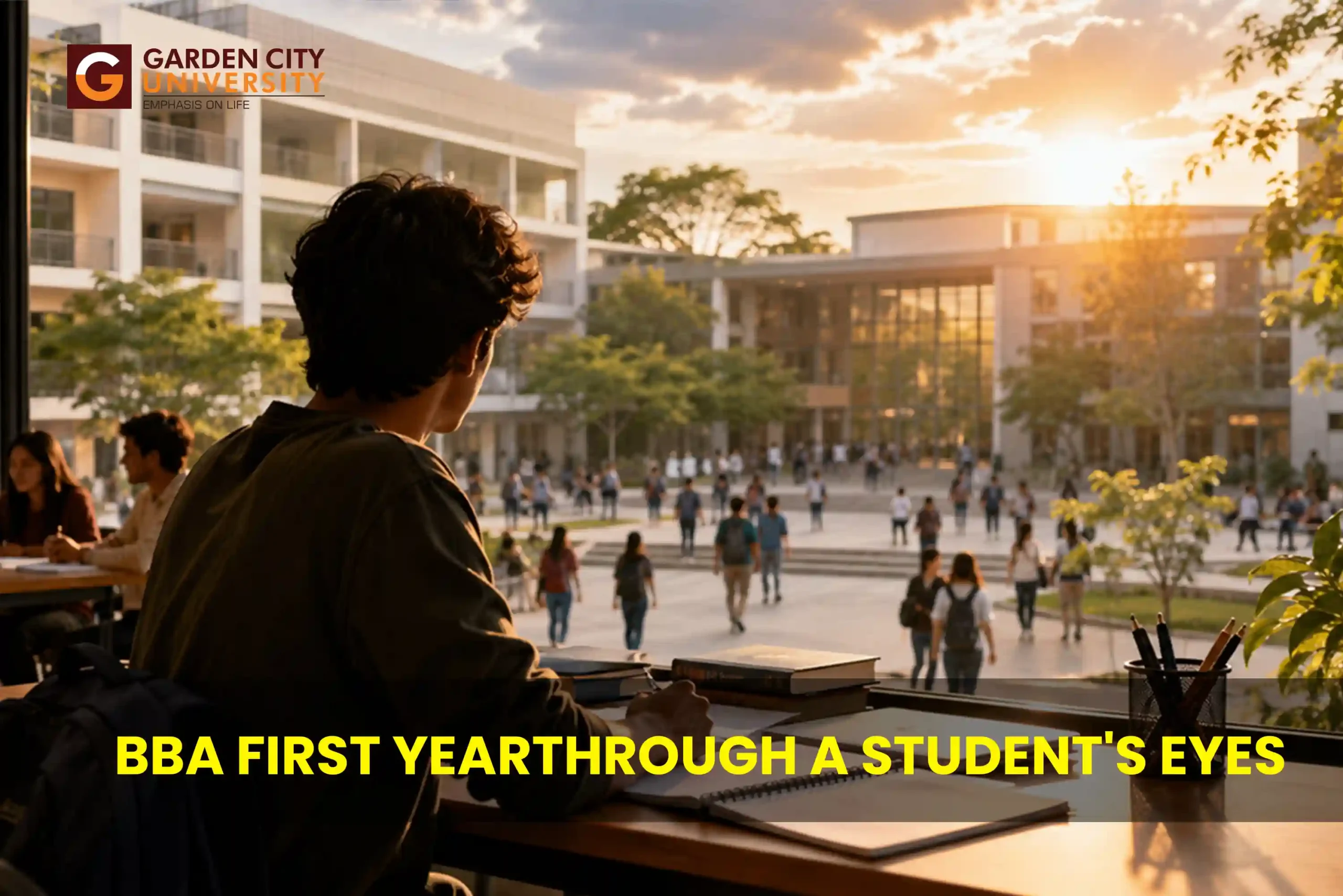
BBA First Year

BBA First Year, Through a Student’s Eyes

BBA first year is the initial twelve months of the Bachelor of Business Administration programme, where students move from school-style learning to a college structure built around business fundamentals, presentations, and group projects. Nobody quite prepares you for how different it feels. You walk in expecting textbooks and exams, and instead you get case studies, pitch decks, and a professor asking you to “just wing it” for a five-minute presentation on Monday morning. That, in a nutshell, is what BBA first year looks like from the inside.

What Actually Happens in BBA First Year

The first thing that hits you is the sheer variety of subjects. In one week, you might study the basics of accounting, jump into a marketing lecture about brand positioning, and then sit through a session on business communication that feels more like a soft-skills workshop than a lecture. This spread across subjects is intentional — it’s how BBA first year is designed to work. The idea behind it is to give students a wide lens before they specialise in finance, marketing, or HR later on.

For example, a typical first-year timetable includes Principles of Management, Financial Accounting, Business Economics, and Business Communication, alongside an elective or two depending on the institution. Because these subjects rarely overlap, students often describe the first few weeks as mentally exhausting but oddly exciting. You are not just memorising facts anymore; you are learning to think in frameworks, like SWOT analysis or the 4Ps of marketing, and applying them to real companies almost immediately.

Assignments also look different here. Instead of long written answers, you get PowerPoint presentations, mock business plans, and sometimes a full-blown roleplay where your group pretends to pitch a product to “investors” (usually your own classmates). It sounds intimidating at first, but most students find it easier to retain concepts this way, simply because they are doing something with the information instead of just reading it.

The Emotional Side of BBA First Year Nobody Talks About

Academically, BBA first year asks a lot of you early on. However, the bigger adjustment is usually social and emotional, not academic. You are suddenly surrounded by people from different cities, different school boards, and sometimes different countries. Some classmates already know Excel shortcuts and speak fluently in front of a group. Others, including many first-timers, feel completely out of their depth during the first month.

That gap closes faster than most students expect. By the second or third month, group projects force everyone to collaborate, and confidence tends to build through repetition rather than natural talent. A student who stumbled through their first presentation in July often delivers a fairly polished pitch by December. That is simply how business education tends to work: it rewards practice over perfection.

There is also the question of time management. Unlike school, where every hour is scheduled for you, this stage gives you free periods, elective choices, and deadlines spread across weeks instead of days. Some students thrive with that freedom immediately. Others need a semester to figure out that procrastinating on a case study submitted three weeks later is a recipe for a stressful weekend.

Skills BBA First Year Quietly Builds

Because BBA first year blends theory with application, certain skills develop almost without students noticing. Public speaking is the most obvious one; by the end of the year, most students have delivered at least six to eight presentations, which is more than many people manage in an entire school career. Teamwork is another. Group assignments teach you how to divide work, handle a teammate who does not pull their weight, and still submit something coherent by the deadline.

Analytical thinking also sharpens quietly through subjects like Business Economics and Financial Accounting, where you start noticing patterns in numbers rather than just calculating them. Meanwhile, tools like MS Excel and basic data visualisation software become part of daily coursework rather than optional extras. For many students, this is the first time they use Excel for anything beyond a school project, and by the end of the year, functions like VLOOKUP or pivot tables no longer feel intimidating.

These small, cumulative skills matter more than they seem to in the moment. Recruiters and internship supervisors later look for exactly this combination: someone comfortable presenting, working in teams, and reading a basic financial statement without panicking.

How to Make the Most of BBA First Year

Because the first year sets the tone for the rest of the degree, a few habits make a real difference. Attending every guest lecture or industry talk, even the ones that sound boring on paper, often pays off later since these sessions occasionally lead to internship leads or mentorship. Similarly, joining at least one student club, whether it is a marketing cell, a finance club, or an entrepreneurship cell, helps students build a network before they even step into a formal internship.

That said, balance matters just as much as ambition. Overloading yourself with every extracurricular activity in the first month usually backfires by October. A more sustainable approach is to pick two or three areas of interest and go deep rather than spreading yourself thin across everything the campus offers.

FAQ

Most institutions include Principles of Management, Financial Accounting, Business Economics, and Business Communication, along with electives that vary by college.

Not particularly. Business fundamentals are taught from scratch, so students from science or arts backgrounds usually catch up within the first two or three months.

Quite a lot. Presentations, case studies, and mock business plans are common, and most students complete six to eight group presentations within the first year alone.

Formal internships are usually reserved for later years, though guest lectures, industry visits, and small live projects often introduce students to real business scenarios early on.

Conclusion

Looking back, this stage of the degree is less about mastering business theory and more about learning how to learn in a completely new format. The subjects matter, of course, but the confidence, teamwork, and time-management habits built along the way tend to matter just as much. If you are exploring where to begin this journey, Garden City University‘s BBA programme is worth a closer look, especially if hands-on, presentation-driven learning sounds like the environment you would thrive in.

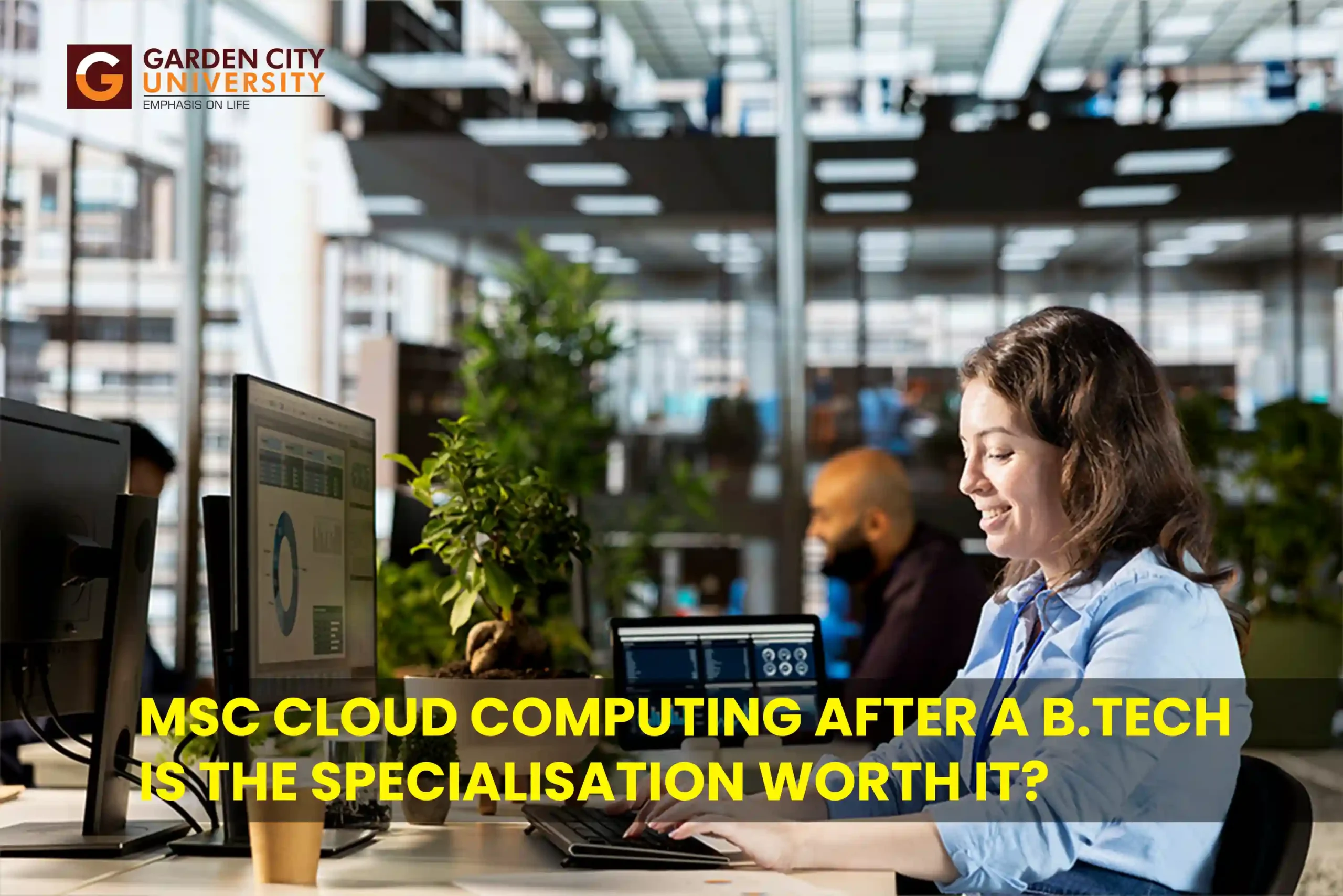
MSc Cloud Computing

MSc Cloud Computing After a B.Tech: Is the Specialisation Worth It?

MSc Cloud Computing after a B.Tech is a one or two-year postgraduate specialisation built around infrastructure, distributed systems, and platforms like AWS, Azure, and Google Cloud. It’s meant for engineering graduates who want to go deep on the systems running behind almost every app and service today. Most B.Tech CSE graduates already come out of undergrad with some exposure to these tools, through internships, hackathons, or a final-year project. That exposure is often just enough to deploy something that works, but not enough to explain why it would fail under real load.

The question most graduates actually ask isn’t what the specialisation covers, though. It’s whether spending another year in a classroom beats learning cloud tools on the job while earning a salary instead. That trade-off shapes almost every decision that follows, from which platforms to focus on to how quickly a career actually moves toward senior, higher-paying roles.

What MSc Cloud Computing Actually Teaches

The core of an MSc Cloud Computing degree goes well beyond knowing how to spin up a virtual machine. Expect deep coursework in distributed systems, containerisation, cloud security, and cost optimisation. Most B.Tech graduates already know the basics of AWS or Azure from projects or internships. This programme pushes past that surface layer. It moves into architecture decisions, scaling strategy, and the trade-offs engineers make when a system needs to handle millions of users.

Group projects also mirror real engineering team structures, with students splitting ownership across networking, security, and deployment rather than working solo. Labs are hands-on rather than theoretical. Students build and break real distributed systems, work through failure scenarios, and learn to design for redundancy, not just functionality. That failure-scenario training is the part most self-taught cloud engineers skip entirely. It’s hard to simulate outside a structured programme.

Is MSc Cloud Computing Worth It After a B.Tech?

The honest answer depends on the starting point. A B.Tech CSE graduate who’s already comfortable with cloud platforms from internships or personal projects gets a smaller lift from this degree. Someone starting from a general engineering background with limited cloud exposure sees a bigger one. For the second group, MSc Cloud Computing closes a real skills gap fast.

Salary data tells a similar story. Entry-level cloud engineering roles don’t strictly require a master’s degree. Plenty of B.Tech graduates land them through certifications and self-study instead. But specialised roles, cloud architect, site reliability engineer, platform lead, tend to favour a different profile. Candidates need either years of experience or a focused postgraduate degree. MSc Cloud Computing compresses that timeline, trading a year of income for a faster path into senior-track roles.

Certifications vs. a Full MSc Cloud Computing Degree

This is the real fork most students face. AWS, Azure, and Google Cloud all offer certification paths that take weeks rather than years, and they’re far cheaper. For someone who just wants to add a credential to an existing job, certifications usually make more sense.

A postgraduate degree earns its cost differently. It’s not really about the certificate at the end. It’s about structured exposure to systems design, security architecture, and large-scale distributed computing. A weekend certification course simply doesn’t cover that ground. Someone chasing a specific cloud certification is optimising for a resume line. Someone doing MSc Cloud Computing is optimising for depth.

Career Paths After MSc Cloud Computing

Placement patterns vary by college, but graduates typically move into cloud engineering, DevOps, site reliability engineering, or cloud architecture roles. Some join cloud-native startups building products entirely on AWS or Azure infrastructure from day one. Others move into enterprise IT teams managing large-scale cloud migrations for established companies.

A smaller group pivots into cloud security specifically. Demand keeps growing for engineers who understand both infrastructure and security compliance. That crossover skill set, systems plus security, tends to command a premium over generalist cloud roles. Fewer engineers genuinely combine both well.

FAQ

No. Many cloud engineers build careers entirely through certifications and hands-on project experience. The degree matters more for senior or architecture-level roles than entry-level positions.

Certifications validate specific platform skills quickly. This degree covers broader systems design, distributed computing theory, and security architecture. It takes longer, but it builds a deeper technical foundation.

It’s most useful for engineering graduates with some programming or systems background. That said, students from other technical branches with genuine cloud interest can also pursue it successfully.

Assuming the degree alone guarantees a senior role. Employers still weigh hands-on project experience and internships heavily alongside the coursework itself.

Conclusion

Whether MSc Cloud Computing after a B.Tech is worth it comes down to two things: where you’re starting from, and how fast you want to move toward senior-level roles. For graduates with limited cloud exposure, it closes a real gap efficiently. For those already comfortable with cloud platforms, certifications plus continued hands-on work might get there just as fast, minus the tuition and the lost year of income. Neither route is wrong; they’re just optimised for different starting points.

What matters most is being honest about which category actually describes you right now, rather than which one sounds more impressive on a resume. Garden City University‘s MSc Cloud Computing programme is worth exploring for students who’ve already weighed that trade-off and decided depth is worth the wait.

College Choice

Why 6 in 10 Students Disagree With Their Parents on College Choice

Survey data suggests roughly six in ten students make a college choice that doesn’t fully match what their parents would have picked for them, with the gap showing up most in stream selection, distance from home, and how much weight a parent’s opinion carries in the final decision. A national survey by the All India Council for Technical Education found that close to 45% of engineering students had chosen their branch based on peer influence or a parent’s suggestion rather than personal interest. A Deloitte study on Indian Gen Z found that 62% of respondents said their parents’ expectations significantly shaped their career choices, a figure close enough to six in ten that it has become something of a benchmark for how often this disagreement plays out. Adding to that, a survey by India Today found that 93% of students are aware of only about seven career options in total, which means most college choice disagreement isn’t really a fight over values, it’s a gap in information on both sides. This report breaks down exactly where that gap shows up between students and parents, and what the numbers say about why it keeps repeating

Where Does College Choice Disagreement Show Up the Most?

The clearest data point comes from distance. A 2026 survey of college applicants and their parents found that 47% of parents preferred a college choice within 400 km of home, compared to just 33% of students who wanted the same. On the other end, 67% of students were open to a college choice farther than 250 miles away, compared to only 53% of parents. That’s a 14-point gap on one side and a 14-point gap on the other, both pointing the same direction: students consistently want more distance and independence in their college choice than parents are comfortable with.

Stream and branch selection is the second major point of college choice disagreement, and the numbers here are larger. The AICTE’s 45% figure on engineering students isn’t a small subset, it represents a large share of one of India’s most-chosen academic paths, where the final college choice often reflects a parent’s comfort with a “safe” branch more than a student’s actual interest. Layered on top of that, India Today’s finding that 93% of students know of only around seven career options suggests the disagreement isn’t always about students wanting something radically different, it’s often about neither side having full visibility into what else is out there.

Why Does College Choice Disagreement Happen So Often?

A parent’s advice is usually built on a job market that’s twenty or more years old, shaped by whichever careers existed and looked stable when they were making their own college choice. Fields like UX design, data science, and product management didn’t exist in their current form back then, which means college choice disagreement often comes down to each side working from information that doesn’t match. This lines up with the 93% figure on limited career awareness, since a parent working from an even narrower set of known options naturally steers a student toward the handful of paths they trust.

The 62% figure from Deloitte’s Gen Z research points to something specific: even when students go along with a parent’s expectation, a majority privately feel that expectation shaped a college choice they’d have made differently on their own. That’s disagreement that doesn’t always show up as an argument, it shows up as quiet compliance with private doubt. Interestingly, a separate Economic Times survey found that 80% of students believe gaining work experience during their education leads to better-paying jobs after graduation, a view that skews more practical than idealistic, and one that doesn’t always match a parent’s more conservative sense of what counts as a “safe” college choice.

Is College Choice Disagreement Between Students and Parents Growing?

It appears to be. Students today have far more independent access to information than previous generations did, comparing outcomes across fields and talking to peers navigating the same college choice in real time. A parent’s advice used to be one of the only input available. Now, with student-led research narrowing that information gap, college choice disagreement surfaces more openly than it might have a decade ago, simply because students have more to compare that advice against. The 80% figure on valuing work experience over pure academic credentials is one sign of this shift, students are increasingly weighing outcomes and practical exposure over the safer, more traditional markers parents tend to prioritise.

How Can Families Reduce College Choice Disagreement?

The data doesn’t suggest parents should step back completely, and most students don’t want that either. What tends to close the gap is giving parents more current, specific information about a field, its coursework, its actual career outcomes, rather than relying on assumptions built from an older job market. If 93% of students only know about seven career options, then closing that same awareness gap on the parents’ side, not just the students’ side, is likely to matter just as much. When that information gap narrows on both ends, the six-in-ten disagreement rate tends to narrow with it.

FAQ

Distance from home and stream or branch selection are the two most common points, with a 2026 survey showing a roughly 14-point gap between how far students and parents each consider ideal.

An AICTE survey found that about 45% of engineering students chose their branch based on peer or parental influence rather than personal interest, often reflecting a parent’s preference for a familiar, “safe” field over the student’s own college choice.

Yes. An India Today survey found that 93% of students are aware of only about seven career options, which narrows the choices both students and parents are even considering before disagreement sets in.

Yes, largely by closing the information gap on both sides. When parents have current, specific details about a field’s prospects and coursework, college choice disagreement tends to ease.

Conclusion

College choice disagreement between students and parents comes down less to conflict and more to two generations working from different, and often incomplete, information. The 45% branch-selection figure, the 62% parental-expectation figure, the roughly 14-point distance gap, and the 93% awareness gap all point to the same underlying pattern, one that eases when both students and parents have better, more current information rather than assumptions from an older job market. Garden City University builds its programme information around exactly this gap, giving both students and parents a clearer, current picture of each course, so the final college choice, whichever way it goes, involves less guesswork on both sides.

I'm looking for...

Trending Searches:

Career Path

M.Sc. in Data Science and Analytics

After completing a M.Sc. Data Science and Analytics at Garden City University (GCU), these are some of the most trending career opportunities:

Data Scientist: Analyzing and interpreting complex datasets to inform business decision-making. Data scientists use statistical techniques, machine learning, and programming skills to extract insights and build predictive models.

Data Analyst: Focusing on interpreting and analyzing data to help organizations make informed decisions. Data analysts work with databases, statistical tools, and visualization techniques to present findings.

Business Intelligence (BI) Analyst: Using data analysis tools to provide insights into business performance. BI analysts create reports and dashboards to assist organizations in strategic planning.

Machine Learning Engineer: Building and implementing machine learning algorithms and models. Machine learning engineers work on developing systems that can learn and adapt without explicit programming.

Big Data Engineer: Designing, developing, and maintaining large-scale processing systems for big data. Big data engineers work with tools like Hadoop and Spark to handle and process massive datasets.

Data Engineer: Building, testing, and maintaining data architecture (databases, large-scale processing systems) for efficient data retrieval and storage.

Quantitative Analyst: Applying statistical and mathematical models to analyze financial data, often in the context of risk management and investment strategies.

Predictive Modeler: Developing models to predict future trends or outcomes based on historical data. This role is prevalent in marketing, finance, and healthcare.

Data Architect: Designing and creating data systems and structures for organizations. Data architects ensure that databases and systems are optimized for data storage and retrieval.

Business Analytics Manager: Overseeing analytics initiatives within an organization, ensuring that data-driven insights contribute to strategic decision-making.

Research Scientist: Conducting research and experiments to develop new algorithms and methodologies in the field of data science and analytics.

Data Consultant: Providing expert advice on data-related matters to businesses, helping them optimize their data strategies and implementations.

Healthcare Data Analyst: Applying data analytics in the healthcare sector to improve patient outcomes, optimize operations, and support medical research.

Fraud Analyst: Using data analytics to detect and prevent fraudulent activities in various industries, such as finance and e-commerce.

Cybersecurity Analyst (with a focus on Data): Analyzing data to identify and prevent security threats and breaches.


Pedagogy and Assessment

M.Sc. in Data Science and Analytics

At Garden City University, our commitment to excellence in the M.Sc. Data Science and Analytics program extends beyond conventional teaching methods. Recognizing the dynamic nature of the field, our pedagogy is designed to empower students with cutting-edge technologies and analytics methodologies, ensuring they are at the forefront of industry trends.

Incorporating a blend of active teaching methodologies, our curriculum places a strong emphasis on practical applications using industry-standard tools and technologies. Students engage in hands-on experiences with leading data science platforms such as Python, R, and SQL, acquiring the skills needed for effective data manipulation, analysis, and visualization.

Our immersive case study assessments are strategically crafted to challenge M.Sc. Data Science and Analytics students to apply their theoretical knowledge using these technologies in real-world scenarios. This approach ensures a deep understanding of data science methodologies and their practical implications.

To foster independent exploration and specialization, we integrate opportunities for students to leverage Massive Open Online Courses (MOOCs) platforms. These platforms enable M.Sc. Data Science and Analytics students to delve into advanced topics, learn about the latest analytics methodologies, and stay abreast of emerging technologies shaping the industry.

The pinnacle of our pedagogical approach is the major project, where students have the freedom to immerse themselves in a subject of their choice. Leveraging technologies such as machine learning, artificial intelligence, and big data analytics, students showcase their expertise and research acumen, preparing them for the dynamic challenges of the data-driven world.

Complementing these experiences is a mandatory six-month internship, providing M.Sc. Data Science and Analytics students with invaluable practical exposure to industry settings. During the internship, students apply their knowledge of analytics methodologies and technologies in real-world projects, gaining hands-on experience and honing their skills for seamless integration into the professional landscape.

Our assessment methods, including internal quizzes, end-semester examinations, viva sessions, case study solving, and field visits, are designed to comprehensively evaluate not only academic knowledge but also practical proficiency in utilizing data science and analytics technologies.

At Garden City University, we are committed to delivering a transformative learning experience that equips M.Sc. Data Science and Analytics students with proficiency in the latest technologies and methodologies. Our pedagogy ensures that graduates are not only well-prepared academically but are also proficient in applying state-of-the-art tools and techniques demanded by the evolving data science and analytics industry.


Physio-United is the alumni startup of Garden City University. This startup focuses on connecting physiotherapist under one platform and link with the potential patients via tele-medicine concept. This startup was founded by Mr. Divaker Kumar.  GCU Incubation Centre helped the startup founder to plan and launch the startup successfully at Garden City University Campus. Link of the videos relating to events and activities conducted by Physio-United is given below,

https://youtu.be/sg9oRlGDbfM?si=Aynn3_AMgq33GFqX

Haura is the under-graduate student startup from the School of Sciences, Department of Life Sciences. This startup focuses on providing beauty and cosmetic products focusing on aromatherapy. This startup was founded by Ms. Darathi Fatima.  GCU Incubation Centre helped the startup founder to plan and launch the startup successfully at Garden City University Campus. Link of the videos relating to events and activities conducted by Haura is given below,

  1. https://youtu.be/cr9S7iqXI70
  2. https://youtu.be/3avEN6tzM0I
  3. https://youtu.be/yW_XstfuJ1Y
  4. https://youtu.be/eH5NRbgVtZs
  5. https://youtu.be/It-KdOTi3KE
  6. https://youtu.be/Lpjz6MfZZnI
  7. https://youtu.be/1ozE-tACzrw

UAV Systems is the external startup of Garden City University. This startup focuses on manufacturing low cost commercial drones. The brand slogan of the startup is “Make drones work for India”. This startup was founded by Mr. Shivaraman. GCU Incubation Centre helped the startup founder to plan various aspects of startups at Garden City University Campus. Link of the videos relating to events and activities conducted by UAV System is given below,

  1. https://youtu.be/twNveHMuyGU
  2. https://youtu.be/lVVblwqxk50
  3. https://youtu.be/08bKFnrrnw0

Woofy is the alumna startup of Garden City University. This startup focuses on providing healthy food for the pets and other pet care services. This startup was founded by Ms. Varsha. GCU Incubation Centre helped the startup to secure funding after reviewing her business plan and the trial done in the market. Link of the video relating to events and activities conducted by Woofy is given below,

https://youtu.be/cT3OZo7M77E?si=OjmzJ_EutaxTYreQ

Bakeluscious is the under-graduate student startup from the School of Professional Studies, Department of Hospitality Management and Catering Technology. This home-based startup focuses on crafting creative bakery and confectionary products by providing high end customization options to the customers. This startup was founded by Ms. Shivani. GCU Incubation Centre helped the startup founder to plan and launch the startup successfully at Garden City University Campus. Link of the videos relating to events and activities conducted by Bakeluscious is given below,

  1. https://youtu.be/A0Ebx3CInJ4
  2. https://youtu.be/2VEkyJWzxh4
  3. https://youtu.be/lzNhdtJ6Gz0

Shaahi Bawarchi is the under-graduate student startup from the School of Professional Studies, Department of Hospitality Management and Catering Technology. This startup focuses on providing authentic culinary experience to the customers visiting the restaurants. The startup also focuses on conducting customized outdoor catering events based on the special requirements of the customers. This startup was founded by Ms. Jasmeet. GCU Incubation Centre helped the startup founder to plan and launch the startup successfully at Garden City University Campus. Link of the videos relating to events and activities conducted by Shaahi Bawarchi is given below,

  1. https://youtu.be/N-G5rIbm3y8

Giggle India is the under-graduate student startup from the School of Professional Studies, Department of Hospitality Management and Catering Technology. This startup focuses on providing various creative services basing the concept of Gig Economy to MSMEs to MNCs. This startup was founded by Ms. Jasneet Kaur. GCU Incubation Centre helped the startup founder to plan and launch the startup successfully at Garden City University Campus. Link of the videos relating to events and activities conducted by Giggle India is given below,

  1. https://youtu.be/BA15Ugl0OKw
  2. https://youtu.be/kBfyArYPmes
  3. https://youtu.be/ArzOTcbVm0k
  4. https://youtu.be/AJRpv0gj_DU
  5. https://youtu.be/kE-Aqxatr3g
  6. https://youtu.be/KECRUe5Asmo

Image Translators is the under-graduate student startup from the School of Professional Studies, Department of Hospitality Management and Catering Technology. This startup focuses on providing image makeover services and access to reliable beauty and cosmetic care products. This startup was founded by Ms. Jasmeet. GCU Incubation Centre helped the startup founder to plan and launch the startup successfully at Garden City University Campus. Link of the videos relating to events and activities conducted by Image Translators is given below,

  1. https://youtu.be/nwz1Jj4yuys
  2. https://youtu.be/JHLcqLuVgPM
  3. https://youtu.be/lHJWouNNAFM
  4. https://youtu.be/JGQS_EcZric
  5. https://youtu.be/pmi88RYDby0
  6. https://youtu.be/bqxCgZz2NSk
  7. https://youtu.be/omSF2yHzCuY
  8. https://youtu.be/7UsoZj8NwXo
  9. https://youtu.be/krLaYDlunK0

Soup Master is the external startup. This startup focuses on providing healthy and tasty soup options in a customized vending machines to varied business and institutional units. This startup was founded by Chef Pakadhruva. GCU Incubation Centre helped the startup founder to plan and launch the startup successfully at Garden City University Campus. Link of the videos relating to events and activities conducted by Soup Master is given below,

  1. https://youtu.be/3ARlwuT2s_E
  2. https://youtu.be/3GzzNrAd-Nk
  3. https://youtu.be/t2yGszNrkc0
  4. https://youtu.be/DMzmz8Rh2GQ
  5. https://youtu.be/0SNu66Im_dw
  6. https://youtu.be/jQtsEpmA77s

Miha Hair Oils is the post graduate student startup from the School of Professional Studies, Department of Fashion and Apparel Design. This startup focuses on creating herbal hair oils using unique techniques and ingredients that helps in

the hair repair, growth and continuous nourishment. This startup was founded by Ms. Annie Miranta Pius. GCU Incubation Centre helped the startup founder to plan and soft launch the startup successfully at Garden City University Campus. Link of the videos relating to events activities conducted by Miha Hair Oils at GCU Campus is given below,

  1. https://youtu.be/t-ghjuXX06U
  2. https://youtu.be/XyJvDKvBUu4
  3. https://youtu.be/gsmC5tWBeTg
  4. https://youtu.be/KnhzFHWVxj0
  5. https://youtu.be/h9k4Tpqb2RM
  6. https://youtu.be/tamJYXycesU
  7. https://youtu.be/CHwDLmEWfow
  8. https://youtu.be/T_cShWXVYfU

First Rate Freelance Academy is the under-graduate student startup from the School of Commerce and Management, Department of Management.  This startup focuses on training Youth to find career and second income opportunities in the Gig Economy. This startup

was founded by Mr. Mohammed Musharaf. GCU Incubation Centre helped the startup founder to plan and launch the startup successfully at Garden City University Campus. Link of the video relating to event and activity conducted by First Rate Freelance Academy is given below,

https://youtu.be/PlIYhNbqMAk?si=1N9ImXU4YlYW75R8

Pedagogy and Assessment

B.Com in International Accounting & Finance in Association with ACCA (UK)

At Garden City University, we believe in the power of active teaching methodologies to create a transformative learning environment specifically designed for our Bachelor of Commerce (B.Com) with ACCA degree course. We are committed to preparing our B.Com students to be truly employment-worthy by providing them with a dynamic and comprehensive pedagogy that integrates practical experiences, independent study, and rigorous assessments. Our pedagogy for the B.Com degree course is tailored to enhance students’ employability and practical skills. We employ immersive case study assessments that challenge B.Com students to apply their knowledge to real-world scenarios, allowing them to develop critical thinking and problem-solving abilities within a business context. To foster innovation and adaptability, we incorporate engaging mini projects into our B.Com curriculum. We understand the importance of independent study in nurturing expertise and passion. Through our integration of Massive Open Online Courses (MOOCs) platforms, B.Com students have the opportunity to explore their areas of interest, delve deeper into subjects of their choice, and enhance their knowledge and skills in specific domains. The pinnacle of our B.Com pedagogy is the major project, which allows students to undertake in-depth research and analysis on a subject of their choice within the commerce field. This project serves as a platform for B.Com students to showcase their expertise, research acumen, and ability to synthesize information. Complementing these enriching experiences is our mandatory six-month internship for B.Com students. This internship provides invaluable practical exposure and bridges the gap between theory and real-world application. B.Com students have the opportunity to apply their classroom knowledge in professional settings, gain industry insights, and develop the skills and networks necessary for success in their future careers.

Our assessment methods for the B.Com with ACCA degree course are diverse and comprehensive, ensuring a holistic evaluation of students’ capabilities. Internal assessment quizzes, end-semester examinations, and viva sessions for projects and internships form an integral part of our evaluation process. Additionally, B.Com students are challenged with case study solving, field surveys, and field visits, which provide practical exposure and hands-on learning opportunities. This multifaceted assessment approach ensures that B.Com students are not only well-prepared academically but also equipped with practical skills, critical thinking abilities, and a deep understanding of real-world applications in the commerce field.

Career Path

B.Com in International Accounting & Finance in Association with ACCA (UK)

A degree in B.Com with ACCA from GCU opens up a wide range of trending career paths in the field of accounting and finance. Here are some of the most sought-after career opportunities:

Chartered Accountant (CA): As a Chartered Accountant, you will be responsible for financial reporting, auditing, taxation, and advisory services. You can work in public accounting firms, corporate organizations, or even establish your own practice. Prominent recruiting companies in India for CAs include Deloitte, Ernst & Young, PricewaterhouseCoopers (PwC), and KPMG.

Financial Analyst: Financial analysts analyze financial data, assess investment opportunities, and provide recommendations to organizations. You can work in banks, investment firms, or corporate finance departments. Companies like Goldman Sachs, Morgan Stanley, HDFC Bank, and ICICI Securities often recruit financial analysts.

Management Accountant: Management accountants work closely with management teams, providing financial insights, developing budgets, and improving overall financial performance. Companies like Tata Motors, Hindustan Unilever Limited (HUL), Larsen & Toubro (L&T), and Reliance Industries often hire management accountants.

Tax Consultant: Tax consultants help individuals and businesses comply with tax regulations, optimize tax planning, and minimize tax liabilities. You can work in accounting firms, consulting firms, or even in-house tax departments of companies. Prominent recruiters in India for tax consultants include KPMG, EY, Deloitte, and Grant Thornton.

Financial Planner: Financial planners assist individuals and families in creating comprehensive financial plans, including investment strategies, retirement planning, risk management, and estate planning. Companies like HDFC Bank, ICICI Bank, Kotak Mahindra Bank, and Bajaj Capital often recruit financial planners.

Internal Auditor: Internal auditors assess an organization’s internal controls, risk management processes, and compliance with regulations. They work in various sectors, including corporate firms, government organizations, and consulting firms. Recruiting companies in India for internal auditors include PwC, Deloitte, Tata Consultancy Services (TCS), and Infosys.

Risk Manager: Risk managers identify and analyze potential risks that may affect an organization’s financial stability. They work in banks, insurance companies, and consulting firms. Companies like State Bank of India (SBI), ICICI Bank, HDFC Bank, and Ernst & Young often hire risk managers.

Investment Banker: Investment bankers provide financial advisory services, assist with mergers and acquisitions, and help clients raise capital. Prominent recruiting companies in India for investment bankers include Goldman Sachs, JP Morgan Chase, Citibank, and Barclays.

Financial Controller: Financial controllers oversee an organization’s financial operations, including budgeting, financial reporting, and compliance. They work in various industries, including manufacturing, services, and IT. Companies like Tata Steel, Aditya Birla Group, Infosys, and Wipro often recruit financial controllers.

Forensic Accountant: Forensic accountants investigate financial fraud, analyze financial evidence, and provide litigation support in legal proceedings. They work in consulting firms, forensic accounting divisions of accounting firms, and law enforcement agencies. Companies like PwC, EY, KPMG, and Deloitte often hire forensic accountants.

Career Path

B.COM Bachelor of Commerce

After completing a B.Com degree at Garden City University (GCU), you will have a wide range of career paths available to you. Here are some of the most trending and sought-after career options that you can pursue:

Financial Analyst: As a financial analyst, you will analyze financial data, perform risk assessments, and provide insights and recommendations to help organizations make informed investment decisions. Companies such as Deloitte, Ernst & Young (EY), and KPMG, renowned for their financial advisory and consulting services, frequently recruit B.Com graduates for financial analyst positions.

Accountant: With a strong foundation in accounting and taxation, you can pursue a career as an accountant in various sectors, including corporate firms, government organizations, or as a self-employed professional. Leading firms like PricewaterhouseCoopers (PwC), Tata Consultancy Services (TCS), and Infosys often recruit B.Com graduates for accounting positions in their finance departments.

Tax Consultant: Specializing in taxation can open up opportunities as a tax consultant, where you provide advisory services to individuals and businesses to ensure compliance with tax laws and optimize tax strategies. Companies such as Grant Thornton, RSM Astute Consulting, and BDO India LLP offer tax consulting services and actively hire B.Com graduates with specialization in taxation.

Investment Banker: If you have a keen interest in finance and banking, you can explore a career in investment banking, where you facilitate corporate finance transactions, mergers, acquisitions, and provide financial advisory services. Top investment banks in India, including Goldman Sachs, and Morgan Stanley, often recruit B.Com graduates for roles in their investment banking divisions.

Financial Planner: As a financial planner, you will assist individuals and families in managing their finances, including budgeting, retirement planning, investment management, and risk assessment. Renowned companies like ICICI Securities, HDFC Bank, and Bajaj Capital provide financial planning and wealth management services, offering career opportunities for B.Com graduates with expertise in personal finance.

Business Analyst: Your understanding of business operations and financial aspects can lead to a career as a business analyst, where you analyze data, identify trends, and provide insights to help organizations improve their efficiency and profitability. Consulting firms like McKinsey & Company, Boston Consulting Group (BCG), and Accenture often hire B.Com graduates as business analysts to help organizations drive growth and streamline their operations.

Auditing and Compliance: With a focus on accounting and taxation, you can pursue a career in auditing, working for auditing firms or within the internal audit departments of organizations to ensure compliance and financial integrity. Firms like EY, KPMG, and PwC have robust auditing and compliance departments and frequently recruit B.Com graduates for positions related to auditing and assurance services.

Entrepreneurship: Your B.Com degree from GCU equips you with the necessary knowledge and skills to start your own business or join a startup. You can launch your own venture or explore opportunities with startup incubators and accelerators like T-Hub, 91springboard, and Indian Angel Network that support and mentor aspiring entrepreneurs.

Financial Manager: In this role, you would be responsible for overseeing the financial health of an organization, including budgeting, financial reporting, and strategic financial planning. Large corporations such as Tata Group, Reliance Industries, and Aditya Birla Group often hire B.Com graduates for financial management roles within their organizations.

Data Analyst: With training in specialized tools such as Advanced Excel and Tableau, you can pursue a career as a data analyst, where you analyze and interpret complex data sets to provide insights and support decision-making processes. Companies like Accenture, Genpact, and Capgemini have analytics divisions that hire B.Com graduates with strong data analysis skills for roles in data analytics and business

Pedagogy and Assessment

B.COM Bachelor of Commerce

At Garden City University, we believe in the power of active teaching methodologies to create a transformative learning environment specifically designed for our Bachelor of Commerce (B.Com) degree course. We are committed to preparing our B.Com students to be truly employment-worthy by providing them with a dynamic and comprehensive pedagogy that integrates practical experiences, independent study, and rigorous assessments. Our pedagogy for the B.Com degree course is tailored to enhance students’ employability and practical skills. We employ immersive case study assessments that challenge B.Com students to apply their knowledge to real-world scenarios, allowing them to develop critical thinking and problem-solving abilities within a business context. To foster innovation and adaptability, we incorporate engaging mini projects into our B.Com curriculum. By working on these projects, B.Com students gain practical experience and learn to think innovatively in order to address complex business challenges.

We understand the importance of independent study in nurturing expertise and passion. Through our integration of Massive Open Online Courses (MOOCs) platforms, B.Com students have the opportunity to explore their areas of interest, delve deeper into subjects of their choice, and enhance their knowledge and skills in specific domains. The pinnacle of our B.Com pedagogy is the major project, which allows students to undertake in-depth research and analysis on a subject of their choice within the commerce field. This project serves as a platform for B.Com students to showcase their expertise, research acumen, and ability to synthesize information. Complementing these enriching experiences is our mandatory six-month internship for B.Com students. This internship provides invaluable practical exposure and bridges the gap between theory and real-world application. B.Com students have the opportunity to apply their classroom knowledge in professional settings, gain industry insights, and develop the skills and networks necessary for success in their future careers.

Our assessment methods for the B.Com degree course are diverse and comprehensive, ensuring a holistic evaluation of students’ capabilities. Internal assessment quizzes, end-semester examinations, and viva sessions for projects and internships form an integral part of our evaluation process. Additionally, B.Com students are challenged with case study solving, field surveys, and field visits, which provide practical exposure and hands-on learning opportunities. This multifaceted assessment approach ensures that B.Com students are not only well-prepared academically but also equipped with practical skills, critical thinking abilities, and a deep understanding of real-world applications in the commerce field.

The Concept of Consultancy at Garden City University​

The concept of consultancy at Garden City University goes beyond the traditional notion, aiming to leverage specialized knowledge and hands-on skills to achieve positive outcomes for individuals, groups, and companies. It serves as a creative platform that enables faculty members to extend their expertise beyond the confines of the classroom. Garden City University boasts an interdisciplinary knowledge pool encompassing fields such as Health Sciences, Life Sciences, Tourism, Hospitality and Catering Technology, Media, Commerce, Management, Computational Sciences and Information Technology, Languages, Fashion and Apparel Design, and Psychology.

One of the unique propositions of Garden City University is its close collaboration with industries, where the expertise of professors is utilized for upskilling, research and development, surveys, evaluation, certification, and more. Highly qualified and experienced faculty members from various departments form the technical consultancy team at the university, ensuring the delivery of high-quality services.

As part of the consultancy offerings, customized corporate training programs are regularly conducted by faculty members across disciplines. These programs can be held either within the university campus or at the premises of partnering companies.

Through consultancy, Garden City University bridges the gap between academia and industry, facilitating the exchange of knowledge, skills, and expertise. By actively engaging in upskilling initiatives, research and development projects, surveys, evaluations, and certifications, the university contributes to the growth and development of industries.

The Guiding Principles for Innovators

  1. Embrace interdisciplinary collaboration:
    Encourage and foster collaboration among individuals from diverse fields and disciplines. Innovation often arises at the intersection of different areas of expertise, so embrace the opportunity to collaborate with researchers, scholars, and experts from various disciplines. This interdisciplinary approach can lead to novel and groundbreaking ideas.
  2. Foster a culture of experimentation and risk-taking:
    Encourage a mindset that embraces experimentation and risk-taking. Innovation involves trying new approaches, taking calculated risks, and learning from failures. Create an environment where innovators feel safe to explore unconventional ideas, challenge the status quo, and learn from both successes and setbacks.
  3. Focus on real-world impact and user-centric design:
    Keep the end-users and their needs at the center of innovation efforts. Strive to develop solutions that address real-world challenges and have a meaningful impact on individuals, communities, or society as a whole. Engage with potential users throughout the innovation process to understand their needs, gather feedback, and iterate on your solutions accordingly.
  4. Promote a culture of lifelong learning and continuous improvement:
    Encourage a culture of continuous learning and professional development among innovators. Innovation is a dynamic process, and it is crucial to stay updated with the latest research, technologies, and trends. Encourage innovators to seek out new knowledge, attend conferences, participate in workshops, and collaborate with experts in their respective fields.
  5. Foster an entrepreneurial mindset:
    Cultivate an entrepreneurial mindset among innovators by encouraging them to think critically, take initiative, and seize opportunities. Provide resources and support for translating innovative ideas into tangible outcomes, whether it be through commercialization, partnerships, or social entrepreneurship. Encourage innovators to think about the scalability, sustainability, and market potential of their ideas.

General Introduction of GCU Clubs

Garden City University (GCU) fosters a vibrant club culture within its educational framework, providing students with a platform to passionately showcase their unique interests beyond the confines of the academic curriculum. With a diverse range of 35 clubs spanning career interests, sports, and cultural & professional domains, GCU empowers students to explore their passions and unlock their full potential. These clubs serve as catalysts for personal growth, enabling students to embark on transformative journeys aligned with their individual areas of fascination.

Through meticulously organized club events, GCU ensures that students engage in a continuous process of self-discovery within their chosen domains. These immersive club experiences equip students with the skills to adeptly navigate various situations, develop multitasking abilities, and generate innovative ideas. Many of GCU’s clubs are pioneers in their respective fields, dedicated to unearthing specific student interests and nurturing them to fruition.

Beyond their individual significance, these clubs collectively contribute to the social and cultural fabric of GCU, enhancing the overall educational environment. They provide students with platforms to showcase their diverse talents and interests while earning valuable credits. GCU clubs transcend traditional extracurricular activities; they serve as dynamic hubs of experiential learning and platforms for exceptional performances. Recognizing the profound impact of extracurricular activities on a student’s life, GCU ensures that each student’s journey towards becoming a well-rounded individual is profoundly impacted, enriched, and transformed during their time at the university.

Moreover, GCU clubs act as catalysts, stimulating the growth of independent thinkers and enhancing students’ leadership capabilities. By fostering a supportive environment, these clubs empower students to become confident, innovative, and influential individuals, ready to make their mark on the world.

Why Bengaluru​

Overview about the city​

Thriving Startup Ecosystem: Bangalore boasts a vibrant and dynamic startup ecosystem, attracting entrepreneurs from around the world. The city is home to numerous successful startups and tech giants, fostering a culture of innovation and entrepreneurship.

Availability of Venture Capital: Bangalore has a robust venture capital industry, with numerous VC firms and angel investors actively supporting startups. This availability of funding options makes it easier for entrepreneurs to secure investments and grow their businesses.

Quality Higher Educational Institutions: Bangalore is renowned for its world-class higher educational institutions, including the Indian Institutes of Science (IISc), Indian Institutes of Technology (IIT) and Indian Institute of Management. These institutions attract talented students and faculty, providing a conducive environment for entrepreneurial activities.

Technological Infrastructure: The city boasts excellent technological infrastructure, including reliable internet connectivity and state-of-the-art research and development facilities. This infrastructure facilitates innovation and research, encouraging entrepreneurs to leverage advanced technologies in their ventures.

Networking Opportunities: Bangalore offers numerous networking opportunities for entrepreneurs through industry events, startup meetups, and conferences. These platforms enable knowledge sharing, collaboration, and the formation of valuable partnerships, enhancing the overall entrepreneurial ecosystem.

Supportive Government Initiatives: The Karnataka government has implemented several initiatives to promote entrepreneurship in Bangalore. These include incubation centers, tax incentives, and policies aimed at simplifying business registration and licensing processes.

Cultural Diversity: Bangalore’s diverse and cosmopolitan population contributes to its entrepreneurial ecosystem. The city attracts talent from various regions, fostering a diverse pool of ideas and perspectives. This diversity fuels innovation and creativity in entrepreneurial ventures.

Skilled Workforce: Bangalore has a vast pool of skilled professionals, particularly in the fields of technology, engineering, and management. The presence of such a talent pool enables startups to recruit top talent, supporting their growth and success.

Access to Industry Experts and Mentors: The city is home to experienced entrepreneurs, industry veterans, and mentors who actively engage with the startup community. These experts provide guidance, mentorship, and valuable insights, helping entrepreneurs navigate challenges and scale their ventures.

Availability of Co-Working Spaces and Incubators: Bangalore offers a wide range of co-working spaces, startup incubators, and accelerators that provide entrepreneurs with affordable office spaces, access to resources, mentorship programs, and networking opportunities. These spaces create a collaborative environment for startups to thrive and exchange ideas.

Overview of the Programme

BSc Fashion & Apparel Design

Welcome to Garden City University (GCU), the premier destination for aspiring fashion and apparel designers in Bangalore. At GCU, we offer a comprehensive and industry-driven B.Sc. Fashion & Apparel Design program that equips students with the necessary skills and knowledge to excel in the dynamic world of fashion. With a focus on practical hands-on learning, industry collaborations, and a holistic approach to education, GCU stands as the best university for pursuing a B.Sc. Fashion & Apparel Design course in Bangalore.

Our curriculum is designed to provide a strong foundation in fashion design while incorporating the latest industry trends and technologies. Key courses such as Fashion Design, Fashion Illustration, Computer-Aided Design, Pattern Making, Garment Construction, and Textile Science ensure that students gain expertise in every aspect of the fashion industry. We also emphasize courses on Fashion Marketing and Merchandising, Fashion Sustainability, Apparel Quality Management, and Boutique Management, enabling students to understand the business side of fashion.

At GCU, we believe in practical learning and exposure. Students engage in live projects that involve creative designing, draping, product designing, and fashion sustainability. Participating in workshops and engaging with designer collections and exhibitions provides them with valuable real-life exposure, enhancing their practical skills. Additionally, students learn about apparel quality management, window display, and fine art, fostering a well-rounded understanding of the industry.

To ensure that our students stay ahead in the digital age, we provide specialized training in software such as Adobe Photoshop and Illustrator, along with hands-on experience with industrial sewing machines. Our skill enhancement courses, participation in renowned fashion events like Femina Stylista 2020, and the opportunity to engage in costume designing for the film industry further enhance their professional growth.

Research-based learning is highly encouraged at GCU. Through collaborations with esteemed organizations like Aditya Birla Fashion Retail Limited, Major Brand India Pvt. Ltd., PVH Arvind Fashion Pvt. Ltd. (Calvin Klein & Tommy Hilfiger), and funded projects with KSCST, students gain valuable industry exposure and research experience. They also have the chance to explore costume designing in the film industry, opening doors to exciting career prospects.

GCU takes pride in its accreditation and collaboration with professional associations. The Graduate Training Programme by Aditya Birla Fashion Retail Limited, Major Brand India Pvt. Ltd., PVH Arvind Fashion Pvt. Ltd. (Calvin Klein & Tommy Hilfiger), Page Industries (Jockey), and Textile Association India testify to the industry relevance of our program. We also collaborate with Anmol Swarn Pvt. Ltd. for Jewellery Designing, Rakhi Fashions, and Raymonds-Silver Spark Pvt. Ltd. for costume designing in the film industry.

Our industry tie-ups with leading export and retail companies like Shahi Exports Pvt Ltd., Arvind Lifestyle Brands, Gokuldas Exports, Aditya Birla Fashion and Retail Limited, Raymonds, Rakhi Fashions, Page Industry Pvt. Ltd., and Pepe Jeans provide our students with excellent internship and employment opportunities.

At GCU, we strive to provide an industry-driven curriculum that prepares our students for successful careers. Apart from the Graduate Training Programme and internships, students get the opportunity to work backstage in international fashion shows, enhancing their industry exposure. We also regularly invite guest lectures and industry speakers, including renowned professionals like Dr. Vikas Kumar from the National Institute of Fashion Technology, Dr. MK Ghandhi from NIFT Chennai, and Ms. Bhavya K S from Kalyan Jewellers, to share valuable insights and inspire our students.

Entrepreneurship opportunities are abundant at GCU, with avenues like the Garden Glam boutique and tie-ups with leading fashion and retail brands. This enables our students to explore their creative and business acumen, turning their passion into successful ventures.

Mentorship programs, on-the-job training, internships, and major projects are integral parts of our B.Sc. Fashion & Apparel Design program. These initiatives provide valuable guidance, industry exposure, and practical experience, setting our students on the path to professional success.

GCU offers professional certifications in various specialized areas such as Fashion Styling and Make-up, Fashion in Interiors, Fashion Art and Culture, Apparel Designing, Testing of Functional and Technical Textiles, and Evaluation of Textile Materials. These certifications add value to our students’ profiles and open up diverse career opportunities.

We also encourage cross-disciplinary collaboration, enabling students to explore unique combinations such as interior designing with Hotel Management, fashion journalism and social media influencer roles with Media Studies, agritech and geotech with Life Sciences, textile research and cosmetic research with Life Sciences, and medical textiles with Physiotherapy. This interdisciplinary approach broadens their perspectives and equips them with a well-rounded skill set.

GCU takes pride in its international university tie-ups, including associations with Dr. Harishkumar Narayan from the University of British Columbia, Canada, and Ms. Rachana Gupta from Cut Japan. These collaborations provide our students with global exposure and opportunities for international learning experiences.

To nurture students’ individual talents and interests, GCU offers specializations in Fashion Design Technology, Textile Science, Fashion Styling and Make-up, Draping, Fashion Event Management, and Fashion Communication. These specializations empower students to focus on their areas of passion and expertise.

Finally, at GCU, we encourage co-curricular activities through various clubs such as Ruffles and Frills, Style Icon of the Year, Portfolio Fashion Show, Navyata Exhibition, and Skill Shows. These clubs provide platforms for students to showcase their creativity, network with industry professionals, and build a strong portfolio.

Garden City University is the ideal destination for students seeking a B.Sc. Fashion & Apparel Design course in Bangalore. With our industry-driven curriculum, practical learning approach, industry collaborations, and global exposure, we empower students to become successful professionals in the fashion industry. Join us at GCU and embark on a journey of creativity, innovation, and endless opportunities in the world of fashion and apparel design.

Overview of the Programme

M.A. English with Specialization in Computational Linguistics

Welcome to Garden City University!

Are you passionate about the English Language and fascinated by the world of Computational Linguistics? Look no further! Garden City University (GCU) is the perfect destination for you to pursue your M.A. in English with a specialization in Computational Linguistics. Here’s why GCU stands out as the best university for this course in Bangalore.

At GCU, we offer a well-rounded curriculum that covers a wide range of subjects, ensuring you receive a holistic education. Our key courses include Language Structure, Literary Theory, Research Methodology, American Literature, European Literature, New Literatures, Gender Studies, Postcolonial Literature, Postmodern Literature, Partition Literature, Python, Translation Studies, Literary Criticism, English Language Teaching, Language and Phonetics, Creative Writing, Fiction and Short Stories, Poetry and Drama, Indian Literature and Natural Language Processing. With this diverse selection of courses, you’ll gain a deep understanding of both language and literature, along with specialized knowledge in Computational Linguistics.

We believe in the power of practical, hands-on learning. At GCU, you’ll have numerous opportunities to apply your knowledge and develop essential skills. Through practical sessions, you’ll enhance your communication skills, creative writing abilities, technical writing expertise, speaking skills, reading skills, listening skills, computational linguistic skills, and natural language processing skills. Our faculty members ensure that you gain valuable experience in using specialized tools such as Python and natural language processing software.

GCU places great emphasis on research-based learning. We encourage students to participate in paper presentations, publish their work, and attend conferences. By engaging in research activities, you’ll have the chance to explore and contribute to the evolving field of Computational Linguistics.

To provide you with real-world exposure, GCU has established strong ties with industry professionals and prestigious organizations. Our collaboration with the Museum of Art and Photography allows you to gain insights into the intersection of language and art. Furthermore, our industry-driven curriculum prepares you for standardized tests such as IELTS, TOEFL, NET, SET, and GATE, opening doors to various career opportunities.

Learning extends beyond the classroom at GCU. We regularly invite guest lecturers and industry speakers who share their expertise and insights. You’ll have the opportunity to attend panel discussions, webinars, seminars, and poetry enclaves, expanding your knowledge and networking with professionals in the field.

GCU encourages an entrepreneurial mindset among its students. Through skill shows, content writing, translation works, proofreading, editing, copywriting, and internship programs, we provide a platform for you to showcase your talents and gain practical experience. Our mentorship programs in administrative management and language skills further enhance your leadership abilities.

GCU believes in broadening your horizons by offering study abroad programs. Our partnership with international universities provides you with the opportunity to engage with a global learning environment and explore diverse perspectives.

This interaction allows you to gain a broader understanding of the applications of Computational Linguistics across various industries.

Beyond academics, GCU offers a lively campus life. Our clubs, including the Gender Sensitization Club, Poetry Club, and Reading Club, provide platforms for co-curricular activities, allowing you to engage in extracurricular pursuits and connect with like-minded individuals.

Garden City University stands out as the premier destination for pursuing an M.A. in English with a Specialization in Computational Linguistics course in Bangalore. Our industry-driven curriculum, practical hands-on learning experiences, research-based approach, industry tie-ups, international collaborations, and comprehensive support systems make GCU the best choice for aspiring literature enthusiasts. Join us at GCU, to embark on your literary passion.

Overview of the Programme

B.A English with Comparative Literature

Welcome to the B.A English with Comparative Literature Programme at Garden City University(GCU) – Unleash Your Literary Journey!

At GCU, we believe in the power of literature to shape our understanding of the world and ourselves.

Our programme offers a rich and multifaceted exploration of literature and its diverse dimensions. It takes into a comprehensive exploration of English Literature and the fascinating field of Comparative Literature, where students learn to analyze and contrast literary works across various languages and cultures.

In the early stages of the programme, students embark on a journey through the rich tapestry of English literature, from its earliest forms to contemporary expressions, thus enabling our students to gain a solid grounding in the major literary periods, iconic authors, and influential literary movements that have shaped the English-speaking world.

The heart of this programme lies in the study of Comparative Literature, where students explore the connections and disparities between literary traditions across the globe. “Comparative Literature: Principles and Methods” introduces students to the intricacies of cross-cultural literary analysis, emphasizing concepts such as literary translation, adaptation, and the role of culture in shaping narratives.

As students progress through the programme, they engage in advanced courses in Literary Theory and Criticism, Contemporary Literary Trends, specialized comparative literature topics (Cultural Studies, Translation Studies, Eco-Literature) honing their analytical skills and acquiring a nuanced understanding of different critical approaches. Topics range from structuralism to feminism, enabling students to critically engage with texts, dissect narratives, and interpret underlying themes and socio-cultural contexts.

In their final year, students are encouraged to undertake a capstone internship project or thesis, delving into a chosen area of study with in-depth research and critical analysis. This culminating experience enables them to demonstrate their mastery of literary scholarship and engage in meaningful discourse within the field.
Furthermore, our faculty comprises esteemed scholars and experts in the field of English literature who are passionate about nurturing the next generation of literary minds. Through interactive lectures, engaging discussions, and personalized guidance, they foster an intellectually stimulating environment that encourages critical thinking and independent research.

Upon completion of the programme, our graduates are equipped with a profound understanding of English literature and the analytical skills necessary for a variety of career paths. They are well-prepared for careers in creative writing, journalism, academia, publishing, and other fields where strong communication and critical thinking skills are highly valued.
Join us at Garden City University and embark on a transformative journey into the world of English literature. Uncover the power of words, explore the depths of human experience, and develop the skills that will propel you towards a successful and fulfilling career in the realm of literature and beyond.

About School of Sciences

The School of Sciences at Garden City University strives to guide students to find cutting-edge solutions to real-world problems to create a positive impact in fields like biodiversity, microbiology, and drug discovery. Several problems are addressed through the programmes in the School of Sciences, from how to exploit enzymes into promising industrial catalysts, to how the issue of antibiotic resistance can be solved. The School of Sciences works together, to develop better crops to feed people, understand the effects of pollution and climate change on various ecosystems, and also how modern life affects the human genomes’ functions. The research-led teaching and curriculum at the School of Life Sciences are focused on developing the necessary skills and enhancing the employability of the students, who will form the next generation of renowned scientists and innovators who will make a difference, not just in India, but across the world.

The innovative teaching methods, depth of research conducted, and state-of-the-art facilities at Garden City University are what elevate this School of Sciences into a leading centre of excellence. Expert faculty members with many years of experience in the field, the School of Sciences is a diverse, yet a close-knit community that pushes the boundaries of life sciences as we know it. At the same time, it forges extensive partnerships with external networks, giving students an opportunity to develop an inquisitive research mindset, while acquiring practical skills, and field techniques, to prepare them for a flourishing and bright future.