
Choosing a university is never just about grabbing a degree at the end. Garden City University makes that abundantly clear from day one. Really, it comes down to how you spend those three or four years in between. The campus vibe, the crowd you run with, the doors that open outside lecture halls, and whether the place actually walks the walk promised in glossy brochures.
Garden City University in Bangalore has quietly been at it since 1992. Backed by a NAAC ‘A’ grade, it spans eight separate schools across a lush 52-acre campus. But let’s be honest: accreditation stamps don’t tell the real story. What actually happens day-to-day on the ground is where things get genuinely interesting. Here is an honest, inside look.
Table of Contents
ToggleA Campus Built to Be Put to Work — Garden City University
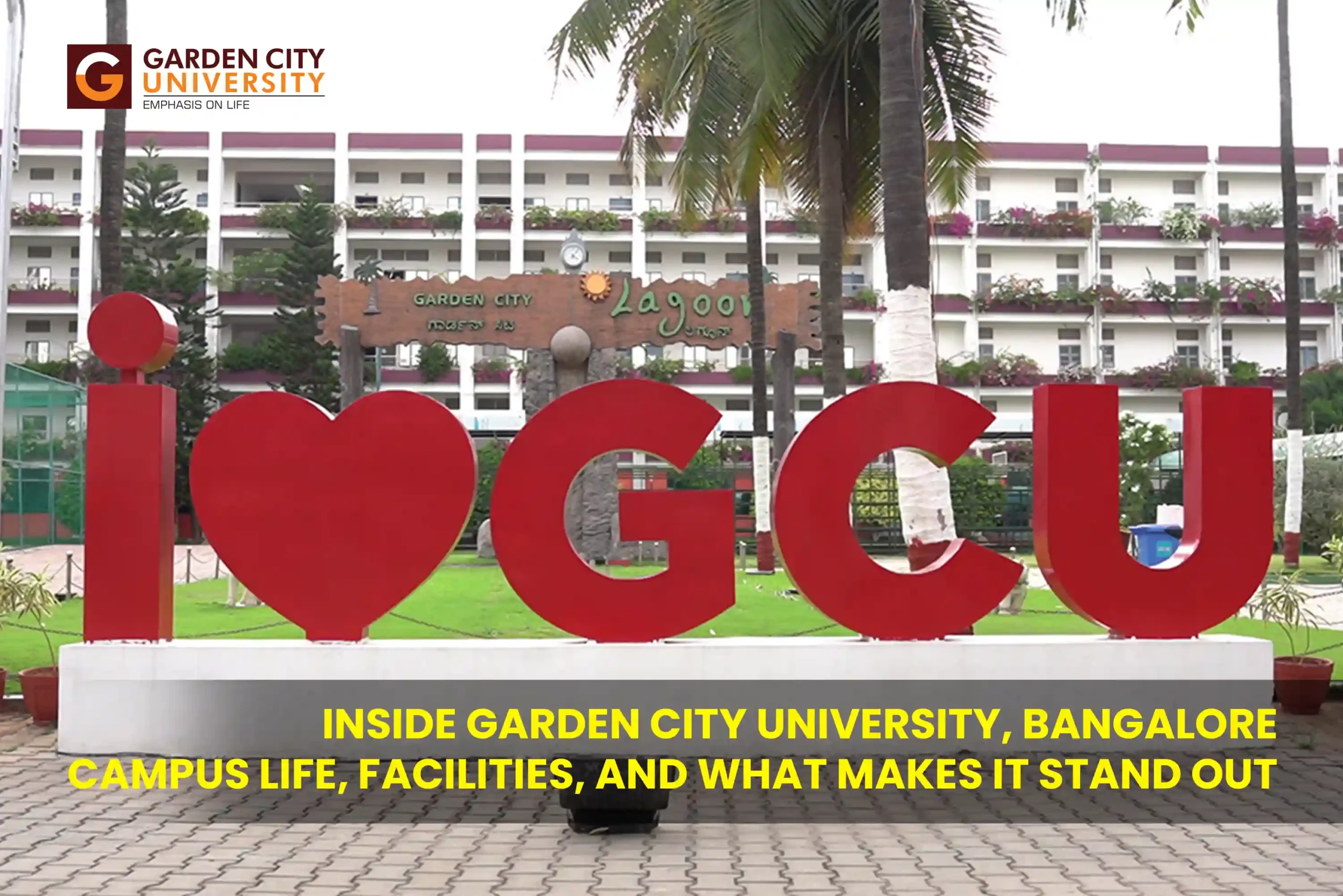
Most college campuses are treated like simple study halls. GCU’s Hoskote campus takes a very different route. Right in the middle of it sits a dense 10-acre Miyawaki forest, planted using the multi-layered Japanese afforestation technique. Because this ecosystem became completely self-sustaining in just three years, Life Sciences and Environmental Science students now treat it as an open-air laboratory. Instead of staring at diagrams in a textbook, they head outdoors to study biodiversity, soil health, and ecology in real time.
And that green thumb stretches much further. The grounds are lined with active cultivation beds growing Ashwagandha, Shatavari, vanilla, orchids, and fresh microgreens. Make no mistake: these aren’t just ornamental garden patches. They are working research plots. Students handle the plants themselves, test modern cultivation methods, and get an unvarnished look at how agricultural products make the journey from raw soil to retail shelves.
You rarely spot details like this on college comparison websites. At GCU, the physical estate isn’t just scenic background noise — it is an everyday teaching tool.
Research That Actually Leaves the Lab
Step into GCU’s research blocks and you will notice a common thread: projects here have real-world stakes, supported by direct government grants.
Take the Department of Life Sciences. Under Dr. Madhu Malleshappa, the team ran a major Ashwagandha National Campaign funded by the Ministry of Ayush. The project distributed more than two lakh saplings to farmers and homes throughout Karnataka. What’s more, the department set up an active buyback agreement with Himalaya Drug Company. As a direct result, students watched classroom pharmacology transition straight into a commercial supply chain.
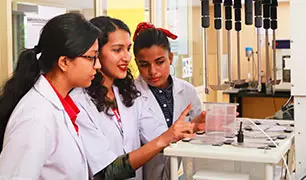
Then you have Dr. L.A. Rama Chandra Prasad, whose lab work moves across several frontiers. For starters, he formulated a viable biodegradable plastic made from simple corn starch. On top of that, his research on chemotherapy drug resistance in leukemia made its way into a Springer Nature publication. Meanwhile, he is tackling regional malnutrition by testing protein-rich diets that pair staple rice with local horse gram. Because students work directly on these problems, several have moved straight into funded PhDs, including one currently running doctoral experiments in the United States.
GCU also happens to be one of just 14 institutions across Karnataka trusted with a dedicated Census Research Lab. Inside sits India’s complete 2011 Census micro-data. Because this archive is kept under tight security protocols, researchers can safely crunch raw numbers for projects bridging AI, behavioral psychology, and state public policy.
None of this is hypothetical talk. These labs are up, running, and turning out tangible results.
Industry Partnerships You Can Actually Feel
Plenty of universities flaunt corporate logos, but the Samsung SEED Linguistics Lab at GCU is one of the rare setups that genuinely pays off for students. Selected as one of only a handful of host institutions in the country, GCU helps train Bixby, Samsung’s flagship AI assistant, across regional and international languages.
Inside the facility, students parse raw datasets sent straight from Samsung HQ. Day in and day out, they translate prompt text and record voice tracks for linguistic fine-tuning. Best of all, they get paid for it. Undergrads pocket monthly stipends of around ₹25,000, while postgraduates take home up to ₹35,000. In fact, several lab alumni have walked directly into full-time language engineering jobs paying ₹70,000 to ₹80,000 a month.
Over in engineering, the university holds a training pact with the Central Manufacturing Technology Institute (CMTI) centered around semiconductor packaging. Right now, only two campuses in the entire country offer this specific hands-on module: GCU and IISc Bangalore.
At the same time, the campus IEEE Student Branch keeps 108 members busy with paper publications, foreign research circles, and funded trips to global academic symposiums.
These aren’t one-off guest lectures designed to fill a calendar. They are structural career pipelines that keep students plugged into actual industry demands.
Life Outside Class: What GCU Students Really Get Up To
Student life here isn’t an afterthought. GCU operates 37 distinct student clubs, and taking part is actually tied to academic credits. Every academic year kicks off with ‘Club Mela’, an energetic half-day fair where students test out different societies before picking two for the term. To earn their activity credits, students must hit an 80% attendance mark, picking up verifiable portfolio credentials along the way.
Then there is Gardenia, the university’s flagship three-day cultural and academic festival that pulls in crowds from across Bangalore’s student circuit. For new arrivals, GCU runs ‘Fresherism’, an intense 15-day onboarding sprint. A gamified point tracker crowns the Top 100 newcomers, culminating in a formal award ceremony on stage with the Chancellor.
Aspiring media professionals run G News, an in-house digital newsroom that produces daily studio broadcasts. Students take turns running cameras, writing teleprompter copy, directing edits, and anchoring live segments. The channel even broadcasts a dedicated Canada edition. Thanks to this daily hustle, several alumni have transitioned directly to network television, including a former graduate who now anchors for Karnataka TV with hundreds of live broadcasts under her belt.
Even the hospitality department has its own traditions. Each year, the Hotel Management wing organizes a legendary Cake Mixing Ceremony. Instead of the standard two-month soak, they age their mixture for an entire calendar year, using a dense 60:40 fruit-to-batter blend packed with fresh ingredients picked right off GCU’s own estate.
Alumni Who Stay in the Loop — and Come Back to Hire
GCU’s alumni network doesn’t vanish into thin air after convocation. Graduates routinely loop back to mentor and hire. Just recently, Mr. Ajit Rai (Class of 2004), now Vice President at Stellar Innovations, returned to campus to run an exclusive placement drive. Similarly, Mr. Abhishek (Class of 2002 Life Sciences), who built a career across tech giants like Microsoft, Uber, LinkedIn, and BrowserStack, now runs a cutting-edge AI venture in Mumbai. When senior graduates actively return to recruit from the same classrooms they once sat in, it says everything about the lasting caliber of the institution.
FAQ
Yes. Garden City University holds a NAAC A-grade accreditation, which reflects its standing against national quality benchmarks across academics, research, infrastructure, and student outcomes.
GCU offers over 70 programmes across eight schools, covering disciplines including Computer Science, Management, Life Sciences, Engineering, Media Studies, Hotel Management, Linguistics, and more — at undergraduate, postgraduate, and doctoral levels.
GCU maintains active corporate relationships that bring companies to campus on a recurring basis rather than limiting recruitment to a single annual season. Alumni-led hiring drives, industry partnerships, and dedicated placement infrastructure contribute to consistent employment outcomes across departments.
Several things are genuinely distinctive: the Samsung SEED Linguistics Lab, the Census Research Lab, the Miyawaki forest campus, the CMTI semiconductor packaging tie-up, and an entrepreneurship lab with CEO and founder mentorship. These are not generic facilities — they are specific to GCU.
Yes. GCU has a significant number of students from Tamil Nadu, Kerala, Andhra Pradesh, and other states, as well as international exchange students. Being based in Bangalore means access to one of India’s most active employment ecosystems, which benefits students regardless of which programme they are enrolled in.
Conclusion
Most universities describe themselves in similar terms. What stands out at GCU is the specificity of what is actually happening — government-funded research producing pharmaceutical partnerships, a Samsung AI lab where students earn while they study, a live campus newsroom with international editions, a 10-acre forest used as a teaching environment, and alumni in senior roles who actively recruit from campus.
The degree is the starting point. What surrounds it at GCU is what makes the difference.