
Breaking into Bengaluru’s job market as a fresh graduate feels like hitting a brick wall. Companies almost always favor candidates who know how real teams operate. Because of that reality, Garden City University flips the standard college playbook. Instead of trapping students in four years of dry lectures, GCU runs daily learning like an active technical apprenticeship.
From week one, you do not simply sit and take notes. Rather, you build things. Every single lab assignment acts as living proof of work. That portfolio gives future hiring managers something concrete to look at long before convocation day.
Table of Contents
Toggle1. Digging Into Real National Datasets
Most colleges teach data science with polished, artificial datasets pulled off the internet. But GCU takes a totally different route. In fact, the university is one of only 14 institutions in Karnataka trusted to host an official Census Research Lab.
Because students get direct clearance to access this archive, they work with verified national figures. You build forecasting tools using genuine data points from the Census of India. As a direct result, you graduate with the instincts of an actual data architect. That exact profile opens doors at top management consultancies and think tanks. After all, you spend your college years processing the exact datasets government planners examine every day.
2. High-Tech Skills: Samsung SEED and Microchip Packaging
GCU deliberately aims for skills where industry demand is huge, but real talent is rare. By teaming up with global tech giants, the campus turns routine labs into working production floors.
Samsung SEED Lab: This facility runs just like a commercial software workspace. Undergrads crunch live conversational data for Samsung’s Bixby voice assistant. In particular, they calibrate emotional speech patterns and translate machine models into French, German, and regional tongues.
The “Earn While You Learn” Setup: Students actually take home a monthly paycheck for their lab contributions. Undergraduates make roughly ₹25,000 every month, while postgraduate researchers draw close to ₹35,000.
Semiconductor Packaging: GCU holds an exclusive training tie-up with the Central Manufacturing Technology Institute (CMTI). Through this project, engineering students pick up cleanroom microchip packaging skills. Because India is pouring billions into domestic chip manufacturing, this specific training gives GCU graduates access to opportunities usually locked behind elite doors like IISc.
3. Science Operations: Moving Lab Discoveries into the Market
Inside the School of Sciences, research does not stay buried in academic journals. Instead, the department focuses on translating lab breakthroughs into viable commercial products.
Herbal Research: Students roll up their sleeves to run field operations for the Ministry of Ayush’s Ashwagandha National Campaign.
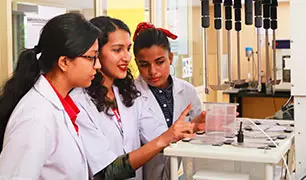
Corporate Quality Benchmarks: Working alongside scientists from Himalaya Drug Company, students practice pharmaceutical audits and chemical testing. So, they learn how raw botanical discoveries scale into real pharmaceutical supply chains.
Living Field Sites: The campus houses its own 10-acre Miyawaki forest. Life Sciences students use this dense canopy to study soil microbiomes and carbon capture. In other words, the campus itself becomes an active testing ground for urban ecology.
4. Running Budgets and Media Studios
True leadership comes from practical repetition, not leadership slides. GCU ensures students gain hands-on experience running both money and modern media.
Managing Budgets: During the annual Club Mela, students organize 37 separate student societies using an event-based funding model. Therefore, student leaders balance authentic bank sheets and direct cross-functional teams across multiple schools.
Studio Production: Over in media, students tap into a dedicated AVGC-XR production floor to broadcast “G News” every single day. In addition, they monitor real-time audience metrics using modern analytics tools. Thanks to that daily routine, GCU media graduates step into professional newsrooms as confident producers from their very first day.
FAQ
It shifts the discussion from what a student knows to what they have done. Managing a national census dataset or running a pharma analysis is “Proof of Work.” These outcomes are documented in our Placement Report.
Yes. Several projects are supported by national bodies like the Ministry of Ayush, providing the work with national credibility. This is what makes the future-ready education through research and industry exposure at GCU different from standard academic projects.
It is an infrastructure for startups. It provides space, mentorship from CEOs, and legal help through the IPR Cell to turn projects into registered companies.
Conclusion
A degree tells an employer you can pass a test; a portfolio tells them you can do the job. The focus on future-ready education through research and industry exposure at GCU ensures you never feel like an amateur when you walk into your first professional role.
By combining national-level data access with high-tech lab training and leadership experience, the university prepares you to lead in the bio-economy and tech sectors. If you’re ready to build a career that begins before you even graduate, evaluating the specialized tracks at Garden City University is the most strategic move you can make for your future.